Funders Want More Than Survival. Can Your Nonprofit Prove Its Impact?
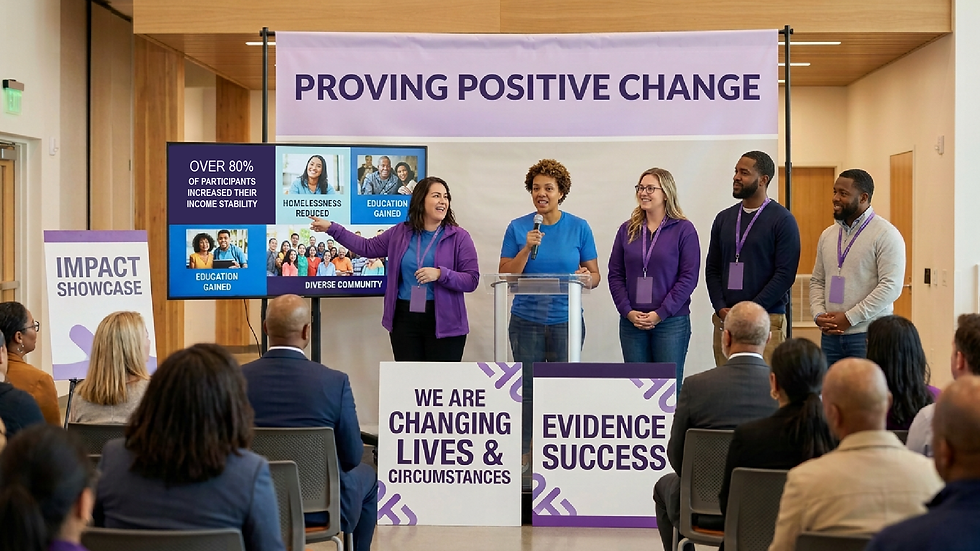
A recent article by Will Jones, Impact Over Survival: Why Donors Should Fund Nonprofits That Thrive, Not Just Survive, raises an important question about philanthropy: Are we funding nonprofits simply to keep their doors open, or are we investing in organizations that can create meaningful, measurable impact?
For nonprofit leaders, there is an important takeaway.
The conversation about funding is changing.
We also recognize that the last two years have created extraordinary uncertainty for nonprofits, with federal funding cuts, changing priorities, and increased demand leaving many organizations focused simply on keeping programs running and serving the people who depend on them. Struggling to survive in this environment does not mean an organization is ineffective or failing. In many cases, it reflects the difficult funding environment nonprofits are navigating.
But even in a challenging funding environment, one thing remains increasingly important: your ability to demonstrate the impact your organization is creating.
Funders want to understand what is changing because of their investment. And increasingly, they want evidence.
Your Mission Matters. So Does Your Ability to Prove It.
As an executive director, you know the story of your organization.
You know the people you serve. You know the challenges your community faces. You know how hard your staff work and the difference they make every day.
But your funders don't always have that same firsthand perspective.
They need another way to understand your organization's value.
That is where outcomes data become critical.
Funders increasingly want to know:
Who are you serving?
What services are you providing?
What outcomes are you achieving?
Are those outcomes improving over time?
Which programs are producing the strongest results?
What have you learned?
How are you using that information to improve your work?
Being able to answer those questions clearly can make the difference between telling a compelling story about your organization and demonstrating one.
Survival Is Not the Same as Sustainability
Nonprofits have always had to worry about survival. There are staff to pay, programs to operate, clients to serve, grants to manage, and bills to cover. And right now, those challenges are particularly acute for many organizations.
But keeping the organization operating is only the beginning. A financially sustainable nonprofit also needs the capacity to understand whether its resources are producing the results its mission promises.
Consider two organizations applying for funding to address the same community need.
Both have passionate leaders. Both serve hundreds of people. Both have dedicated staff. Both can describe the programs they provide.
But one can also show:
Here is the population we serve;
Here is what we are trying to change;
Here is how we measure that change;
Here are the results we've achieved;
Here is what we've learned;
And here is how we are using that information to improve our programs.
That organization gives a funder something extremely valuable: confidence.
Strong Nonprofits Don’t Just Do More. They Know What Works.
The goal isn't simply to collect more data. It is to understand your organization's impact well enough to make better decisions.
When you can connect your activities to outcomes, you can begin to see where your organization is creating the greatest value.
Maybe one program consistently produces stronger outcomes than another.
Maybe certain populations respond particularly well to a specific intervention.
Maybe participants who receive multiple services achieve better long-term outcomes.
Maybe your results are improving, but only for certain groups.
Those insights can change how you allocate staff time, design programs, pursue funding, and communicate with your board.
Your outcomes data should help you run your organization, not just complete your grant reports.
Your Funders Are Asking a Bigger Question
Historically, much of nonprofit reporting has focused on activities.
How many people did you serve?
How many meals did you provide?
How many counseling sessions did you conduct?
How many people completed the program?
Those numbers are important. But they don't necessarily tell a funder whether the investment made a difference.
Funders increasingly need to connect their dollars to results.
That means the conversation is moving from “What did you do with our funding?” to “What happened because we funded you?” And ultimately, “What could happen if we invested even more?”
If your organization can't answer those questions, you may be leaving an important part of your story untold.
Don't Wait Until the Grant Report to Measure Impact
One of the biggest mistakes nonprofits can make is treating outcomes measurement as something that happens when a funder asks for it.
By then, it may be too late.
If you want to demonstrate your organization's impact, you need to be measuring it throughout the year.
That means having a clear understanding of:
Your intended outcomes. What change are you trying to create?
Your measures. How will you know whether that change is happening?
Your data. What information do you need to collect?
Your results. What is the data telling you?
Your decisions. What are you going to do differently because of what you've learned?
When those pieces are connected, reporting becomes much easier because you're not scrambling to reconstruct your impact at the end of a grant period. You're already managing it.
Capacity Is Part of Your Impact Strategy
There is another important implication for nonprofit leaders.
If funders expect organizations to demonstrate outcomes, then the infrastructure required to measure and manage those outcomes is no longer a nice-to-have.
It is part of your organization's capacity to succeed. That may include investing in technology, staff training, data management, evaluation, or processes that help your team consistently capture and understand information.
Those investments aren't taking resources away from your mission. They help you understand whether you're achieving it. And they give you something powerful when you're sitting across the table from a funder: evidence.
Make Your Impact Impossible to Overlook
You shouldn't have to convince funders that your organization does important work. But you do need to make it easy for them to see the results of that work.
Your mission tells people why you exist.
Your programs tell people what you do.
Your outcomes tell people what changes because you do it.
And your data gives you the evidence to demonstrate that change.
As the funding environment becomes more focused on results, nonprofit leaders who can clearly connect their work to measurable outcomes will be better positioned to communicate their value, strengthen relationships with funders, and make strategic decisions about where to invest their limited resources.
The question isn't whether your nonprofit is doing meaningful work. You already know it is. The question is "Can you prove the difference you're making?"
Ready to Turn Your Outcomes Into Evidence of Impact?
SureImpact helps nonprofit organizations connect the work they do every day to the outcomes they are trying to achieve. With the right data and insights, you can spend less time piecing together reports and more time understanding what is working, communicating your results, and making informed decisions about where to focus your resources.
Take a self-guided tour to learn how SureImpact can help your organization measure, manage, and prove its outcomes and impact.


