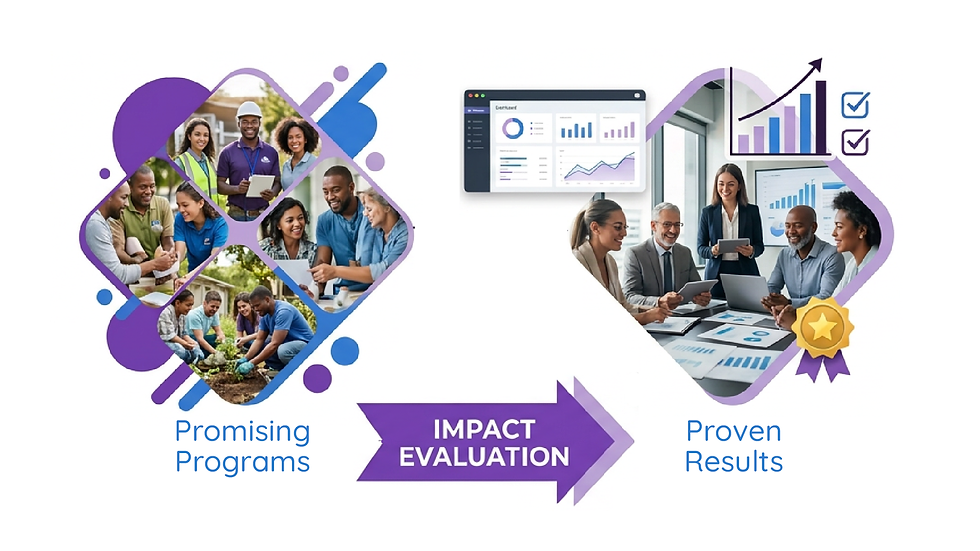
From Promising Programs to Proven Results: The Role of Impact Evaluation
By Sheri Chaney Jones, CEO and Founder of SureImpact
Nonprofit leaders want to know that their programs are making a meaningful difference in the lives of the people and communities they serve. Demonstrating that impact starts with reliable data, consistent outcome measurement, and a clear understanding of the changes their programs are designed to achieve.
For organizations seeking stronger evidence of effectiveness, rigorous impact evaluation can help determine whether a program is responsible for the outcomes observed. But whether or not a nonprofit pursues formal research, a solid data infrastructure is essential for tracking results, improving programs, and communicating value to funders.
I recently explored these topics with Mara Trionfero Lucas, Project Development Associate at the Wilson Sheehan Lab for Economic Opportunities (LEO) at the University of Notre Dame, during our SureImpact webinar, What Funders Want: Building the Evidence Needed to Scale and Grow Your Impact. Our conversation highlighted how nonprofits can strengthen their data practices, prepare for potential research partnerships, and use credible evidence to guide decisions, build funder confidence, and extend the reach of successful programs.
What Data Should Nonprofits Be Collecting to Prepare for Rigorous Evaluation?
One of the most practical questions I asked Mara was what nonprofits should begin collecting today if they hope to participate in rigorous research in the future.
Her response highlighted three foundational elements of effective data management.
1. Individual Participant Information
Researchers need a reliable way to identify participants and connect their records across different data sources.
For example, a workforce development organization might collect participant information that can eventually be connected, through appropriate data sharing arrangements, to administrative records documenting employment, earnings, or other outcomes.
Mara explained that LEO frequently works with administrative data from government agencies and other systems. These records allow researchers to study outcomes that extend beyond the information a nonprofit collects directly.
Organizations preparing for this type of evaluation should establish consistent procedures for collecting and securely maintaining participant information. Privacy protections, consent requirements, and responsible data sharing practices are essential considerations.
2. Program Participation and Service Data
Nonprofits should understand how people enter, participate in, and complete their programs.
Mara encouraged organizations to track measures including the number of new applicants, eligibility determinations, program enrollment, demand for services, and completion rates.
This information helps researchers understand how an intervention operates and whether an organization has the capacity and participant volume necessary for a meaningful study.
Mara noted that LEO's studies often require at least several hundred participants, potentially enrolled over multiple years, with the precise number determined through statistical analysis.
She also encouraged organizations to retain appropriate application records for individuals they are unable to serve. These records can help researchers understand program demand and identify potential comparison opportunities.
3. Consistent Outcome Measurement
Organizations should establish clear definitions of success and collect outcome information consistently.
At SureImpact, we frequently talk about understanding three essential dimensions of performance: who we serve, how well we serve them, and how people are better off as a result.
When those measures are connected to individual participant records, nonprofits can examine relationships between services and outcomes, identify patterns, and prepare for more advanced research.
This creates a foundation for understanding how program activities contribute to improvements in participants' lives.
Research Readiness Requires More Than Good Data
Mara explained that research partnerships require organizational commitment alongside strong data systems.
LEO's studies typically last three to five years. Participating organizations must be prepared to maintain their programs, collaborate with researchers, and commit staff time throughout the evaluation.
LEO looks for leadership teams that support evaluation, clearly defined programs with measurable outcomes, operational stability, and sufficient staff capacity to coordinate with researchers.
Mara also shared that LEO provides research services to participating organizations at no cost. Organizations must still consider the internal resources and operational commitments involved.
Perhaps the most significant requirement is a willingness to learn from the findings, including results that may challenge existing assumptions about a program's effectiveness.
Why Data Infrastructure Is Essential for Building Credible Evidence
One of the strongest connections between Mara's work at LEO and our work at SureImpact is the importance of reliable data infrastructure.
During the webinar, Mara highlighted two characteristics of effective data systems: consistency and accessibility.
When organizations operate multiple programs or locations, they need consistent data collection practices across their teams. Staff members should understand what information to collect, how to record it, and how it connects to the organization's intended outcomes.
For example, a nonprofit providing case management, financial assistance, and employment support may have several professionals working with the same participant.
If those professionals maintain disconnected records or use inconsistent definitions, understanding the participant's complete experience becomes difficult.
A shared system that connects participant information, services, and outcomes creates opportunities for more meaningful analysis.
Data quality is equally significant. Duplicate records, missing fields, and inaccurate entries create challenges when organizations attempt to analyze results or share information with researchers.
Technology can help organizations establish standardized processes, improve consistency, and make information more accessible to authorized users. Staff training and organizational commitment are equally necessary for maintaining accurate records.
At SureImpact, we believe nonprofit technology should help organizations build this foundation through consistent data collection, individual outcome tracking, and accessible reporting.
These capabilities support everyday program management while helping organizations prepare for more rigorous evaluation.
How Research Helped a Homelessness Prevention Program Grow
One of the most compelling portions of our webinar was Mara's discussion of Destination: Home, a homelessness prevention initiative in Santa Clara County, California.
The program provides fast, flexible financial assistance to families facing imminent homelessness, with access to supportive services when needed.
LEO began working with Destination: Home in 2017 to evaluate whether this intervention reduced homelessness.
The findings demonstrated significant results. People who did not receive the assistance were approximately three times as likely to experience homelessness as those who received it. The evaluation also estimated that every dollar spent on emergency financial assistance generated $2.47 in societal benefits.
The research found that the reduction in homelessness persisted over the study's follow-up period.
Mara explained that the research also influenced the program's funding. According to her account, Destination: Home initially relied on approximately 80% private funding. Following the research findings, its funding mix shifted to approximately 80% public funding.
The work has since contributed to Right at Home, a five-year initiative designed to test and extend the model across different communities.
According to the materials Mara presented, the initiative's goals include serving 10,000 to 15,000 households through 10 pilot sites nationwide, conducting rigorous evaluation, and supporting broader adoption.
The research will examine whether the model can produce similar results in communities with different characteristics and needs.
For nonprofit leaders, this example illustrates how credible evidence can help attract larger investments, strengthen partnerships, and create opportunities to replicate successful programs.
How Stronger Evidence Can Support Nonprofit Funding
The connection between impact evidence and financial sustainability was a central theme throughout our webinar.
Mara explained that funders increasingly want confidence that their investments support interventions with demonstrated effectiveness and the potential for lasting results.
Rigorous evaluation can help nonprofits build that confidence in several ways.
First, evidence can strengthen organizational credibility. A nonprofit that willingly participates in independent evaluation demonstrates a commitment to accountability and learning. Funders gain greater insight into the organization's operations, its effectiveness, and its approach to improvement.
Second, evidence can support longer-term funding conversations. When organizations can demonstrate that participants experience sustained improvements, they have a stronger foundation for discussing investments that extend beyond a single grant cycle.
Third, research can support replication and growth. Funders interested in bringing successful interventions to additional communities can use evaluation findings to assess whether an approach warrants further investment.
Fourth, credible evidence can help organizations engage policymakers and public funding institutions. The Destination: Home example demonstrates how research findings can contribute to decisions about public investment in social programs.
During our discussion, I also shared findings from SureImpact's research showing an association between organizations' use of impact data and reported revenue growth.
In the research I referenced, 68% of organizations with the relevant impact data reported increased revenues over the previous two years, compared with 18% of organizations without that data.
These figures describe an association rather than proof that impact measurement caused revenue growth. Funding outcomes are influenced by many factors, including economic conditions, organizational strategy, and changes in government support.
Still, the difference illustrates why I believe nonprofit leaders should view impact measurement as an important component of their financial sustainability strategies.
Organizations that can communicate credible results are better equipped to demonstrate their value and participate in evidence-focused funding conversations.
How Nonprofits Can Start Building Their Evidence Today
Organizations interested in stronger impact evidence can begin preparing well before they pursue a formal research partnership.
Based on our webinar discussion, I recommend five practical steps.
1. Define the Outcomes Your Organization Wants to Achieve
Start by identifying the changes your programs are intended to create.
Consider both immediate improvements and longer-term results. A workforce development program, for example, might measure training completion, employment placement, job retention, and earnings growth at different stages.
Mara highlighted the importance of selecting outcomes that reflect the intervention's purpose.
2. Establish Consistent Data Collection Practices
Review how your organization collects participant information, service records, and outcomes.
Identify gaps, inconsistencies, and opportunities to standardize processes across staff members and programs.
Pay particular attention to whether individual participant records can be connected to the services they receive and the outcomes they experience.
3. Understand Your Program's Capacity and Demand
Document how many people apply for services, how many qualify, how many participate, and how many complete the program.
These measures help organizations understand their operations and provide information that researchers may need when considering evaluation designs.
4. Build Leadership Support for Evaluation
Discuss the value of evidence with your executive team and board.
Connect impact evaluation to organizational priorities such as funding sustainability, program effectiveness, strategic growth, and responsible stewardship.
Mara suggested that examples of successful research partnerships can help leaders understand the potential benefits of evaluation.
5. Identify Opportunities for Research Partnerships
Organizations with established programs and reliable data may be ready to explore partnerships with research institutions such as LEO.
Mara described an initial process that begins with a conversation about the organization, its intervention, and potential research questions.
From there, LEO works with prospective partners to assess research readiness and develop proposals for suitable projects.
For organizations still developing their measurement practices, the same readiness criteria can provide useful direction for future planning.
Measuring Short, Medium, and Long-Term Outcomes
During the audience questions, we discussed another challenge that many nonprofits face: how to demonstrate progress when the ultimate outcomes they seek may take years to appear.
For example, an early childhood education program may aim to improve educational attainment or long-term economic mobility. Those results can take many years to measure.
Mara explained that researchers often work with organizations to identify meaningful intermediate outcomes that indicate whether participants are making progress.
These measures may include improvements in knowledge, behavior, skills, stability, or other indicators connected to the organization's theory of change.
The appropriate measures depend on the intervention and the evidence connecting intermediate results to longer-term outcomes.
This is an area where ongoing impact measurement provides tremendous value.
Organizations can track immediate and intermediate results as part of routine service delivery, while more extensive research may help evaluate longer-term effects.
At SureImpact, we encourage organizations to establish clear connections between their mission, the services they provide, and the outcomes they expect participants to achieve.
When these elements are documented consistently, nonprofit leaders gain information they can use to improve programs, communicate results, and prepare for future evaluation opportunities.
Building a Stronger Future Through Evidence
My conversation with Mara reinforced the tremendous opportunity nonprofit leaders have to connect their commitment to social change with stronger evidence of effectiveness.
Organizations already possess valuable knowledge about the people they serve and the challenges their communities face. When that knowledge is supported by reliable data, consistent outcome measurement, and rigorous research, it becomes possible to understand which interventions are producing the intended results.
The Destination: Home and Right at Home initiatives demonstrate what this progression can look like. An organization begins with a promising intervention, develops evidence of its effectiveness, uses that evidence to attract investment, and works with partners to test whether the model can help people in additional communities.
Every nonprofit has a different mission, operating model, and level of research readiness. The starting point is developing a clear understanding of who you serve, what services you provide, and how participants are better off.
From there, organizations can strengthen their data practices, build a culture of learning, and explore opportunities to establish more rigorous evidence.
At SureImpact, we believe that organizations deserve access to the tools and information needed to understand their effectiveness and communicate their results.
When nonprofits can demonstrate the value of their work, they are better positioned to earn funder confidence, make informed decisions, and pursue the resources needed to help more people.
The future of nonprofit funding will increasingly reward organizations that can connect their mission to credible evidence of results. The work of building that evidence can begin today.
Take the Next Step: Strengthen Your Impact Measurement Practices
Building credible evidence begins with a clear measurement strategy and reliable information about the people and communities you serve.
Download SureImpact's Ultimate Guide to Impact Measurement to learn how to define meaningful outcomes, establish consistent data collection practices, and use impact information to improve programs and communicate results to funders.
You can also explore how SureImpact helps nonprofits collect participant information, track services and outcomes, and analyze their results through our interactive SureImpact Analytics tour.


